☕ Pull Up a Chair, Grab Your Favorite Beverage, and Stay Awhile...
When we left our travelers in the last chapter, they had finally completed their long journey east.
The wagons had arrived.
The steamer trunks had been unloaded.
The horses were finally given a well-earned rest.
After such a long journey, most folks probably believed the hardest part was behind them.
After all, Congress had passed the Debt Collection Improvement Act of 1996, eligible delinquent debts were making their way to Treasury, and everyone was beginning to settle into their new roles.
Surely everything would fall neatly into place now.
Well...
Not exactly.
Because as people gathered around the new settlement comparing notes about regulations, procedures, and the work still ahead, a different kind of rumor began making its way from one conversation to the next.
At first, it was little more than a whisper.
Someone overheard it while unloading another steamer trunk.
Someone else mentioned it while pouring another cup of coffee.
Before long, the whole settlement seemed to be talking about the same thing.
"I hear there's gold around here."
Gold?
Here?
Nobody had traveled east looking for gold.
They came because Congress had given them a job to do.
Yet the rumor refused to go away.
Some folks laughed it off.
Others quietly wondered if there might be something to it.
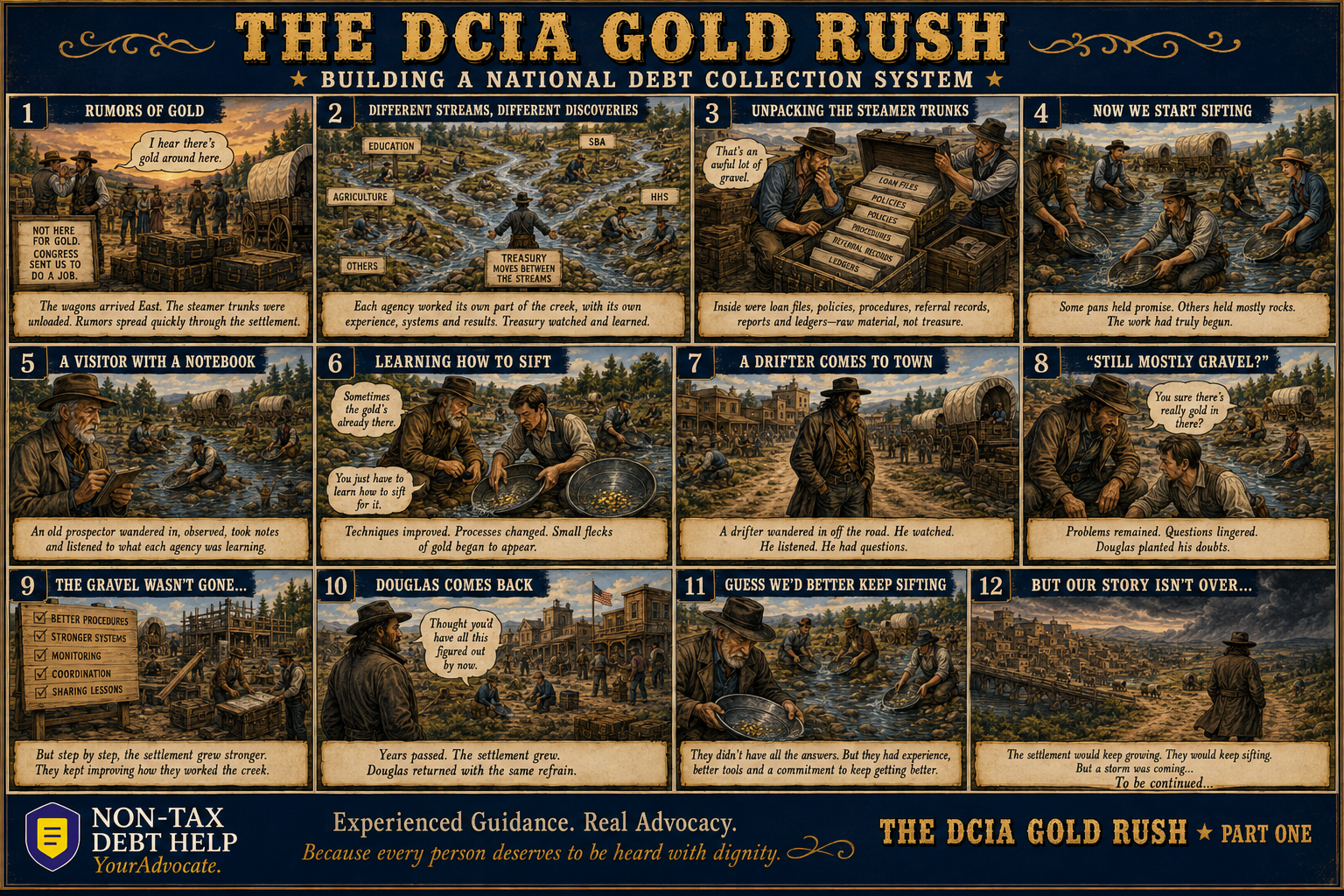
The settlement had been built where several small distributaries flowed toward the same larger creek.
It seemed like as good a place as any to investigate a rumor.
So, before long, a few curious souls wandered down to the water's edge carrying nothing more than a gold pan and a healthy dose of curiosity.
Different Streams, Different Discoveries
The little settlement soon became a busy place.
Different agencies worked different parts of the waterway, bringing with them their own experience, procedures, systems, and ways of doing things.
Education settled along one bend in the creek.
SBA wandered a little farther downstream.
Others found places of their own.
Treasury spent much of its time moving between them, watching what everyone was discovering and trying to bring the pieces together.
Before long, friendly conversations began drifting across the water.
Education smiled as another pan moved gently through the water.
"We've been working this kind of creek for a while," one of them said with a grin.
Across the way, another group wasn't having quite the same experience.
One fellow stared into a pan filled mostly with rocks.
"I'm not even sure we're getting the right gravel."
That earned a few knowing chuckles from around the creek.
And our imaginary prospectors weren't imagining the differences.
In the years following passage of the DCIA, federal agencies really were at very different stages of implementation. Some already had experience with collection tools that others were only beginning to develop. Education, for example, had been using administrative wage garnishment under separate statutory authority since 1993, while years after the DCIA's passage, other agencies were still working through how they would implement AWG, including policies, procedures, regulations and hearing processes. GAO documented those differences in its 2002 review.
GAO: Debt Collection Improvement Act of 1996: Status of Selected Agencies' Implementation of Administrative Wage Garnishment
Everyone may have arrived in the same settlement.
That didn't mean they all arrived with the same map.
Unpacking the Steamer Trunks
Treasury wandered over carrying a cup of coffee.
He looked toward the neatly stacked steamer trunks sitting along the edge of the settlement.
Then he smiled.
"Well..."
"I suppose we're not going to find much gold until somebody starts unpacking those trunks."
"I thought unloading them was the hard part," someone replied.
Treasury chuckled.
"Nope."
He rested his hand on one of the trunks.
"That's where the real work begins."
Someone finally lifted the heavy lid.
Inside wasn't glittering treasure.
It was loan files.
Policies.
Procedures.
Referral records.
Computer reports.
Ledgers.
Enough paperwork to fill a small room.
One fellow stared inside for a long moment before letting out a low whistle.
"That's an awful lot of gravel."
Treasury smiled.
"Exactly."
"Now we start sifting."
For a few moments, nobody said a word.
Because everyone standing around that trunk suddenly understood something they hadn't realized before.
The wagons hadn't carried gold to Treasury.
They had carried the raw material.
Questions waiting to be answered.
Systems waiting to be improved.
Procedures waiting to be written.
Ideas waiting to be tested.
The treasure wasn't sitting on top waiting for someone to pick it up.
It was buried inside all the work that still lay ahead.
In the real world, that work was substantial. GAO found that agencies encountered difficulties identifying which delinquent debts were eligible for referral, getting those debts to Treasury promptly, and determining whether exclusions from referral requirements were appropriate. Treasury itself was also working through the challenges of building Cross-Servicing into a government-wide operation. GAO described these growing pains in its examination of agencies' implementation of key DCIA provisions.
GAO: Debt Collection Improvement Act of 1996: Agencies Face Challenges Implementing Certain Key Provisions
Sometimes the problems were surprisingly practical.
At the Centers for Medicare & Medicaid Services, for example, GAO found inadequate procedures and controls that hampered the prompt identification and referral of eligible debts. Problems with CMS's debt-referral system contributed to delays, and GAO found that CMS had not reported reliable Medicare debt information to Treasury as of September 30, 2000.
GAO: HHS's Centers for Medicare & Medicaid Services Faces Challenges to Fully Implement Certain Key Provisions
There was plenty of gravel to sift through.
A Visitor With a Notebook
For a while, everyone quietly worked the creek.
Sometimes a pan produced another rock.
Sometimes another handful of sand.
Every now and then someone would pause because something looked promising.
Then one afternoon, an older fellow wandered into the settlement carrying a weathered notebook.
He made his way from one distributary to another, quietly watching the prospectors at work.
He didn't interrupt.
He simply watched.
Every now and then, he scribbled something in his notebook.
Finally, someone looked up from the creek.
"Well?"
The old fellow smiled.
"Mind if I share a few observations?"
Everyone gathered around.
He opened the notebook.
"Some of these streams seem to be producing more than others."
A few heads nodded.
"Some folks are still sorting through their gravel before they even begin panning."
More nods.
"And it looks like everyone has developed their own way of working the creek."
Nobody argued.
After all, he wasn't there to work anyone's claim.
He was there to take a careful look at what was happening and point out where the prospectors might improve their technique.
Our old prospector has a real-world counterpart.
During the early years of DCIA implementation, the U.S. General Accounting Office, now the Government Accountability Office, repeatedly examined how agencies and Treasury were putting the new law into practice. GAO looked at difficulties identifying eligible debt, obstacles delaying referrals, agency exclusions from referral requirements, and weaknesses that prevented the government from fully realizing the benefits Congress intended.
GAO: Agencies Face Challenges Implementing Certain Key Provisions
Some of its findings showed just how differently the streams were flowing.
At Agriculture's Farm Service Agency, for example, GAO found weaknesses in procedures and controls for identifying and promptly referring eligible delinquent debts. GAO recommended automated system improvements that would help identify eligible judgment debts and better track their status. Those recommendations were later implemented, including enhanced system-generated reports that field offices could use to determine which debts were eligible for referral.
GAO: Department of Agriculture's Farm Service Agency Has Not Yet Fully Implemented Certain Key Provisions
The old prospector closed his notebook.
Treasury looked around the circle.
"Sounds like we've all been finding different things."
The old fellow smiled.
"That's to be expected."
He glanced toward the creek.
"The important part is that everyone's willing to look at what they're finding and learn from it."
Learning How to Sift
Not everyone was convinced.
One of the prospectors stared into another pan full of gravel and sighed.
"Think we need bigger pans?"
The old prospector smiled.
"No."
He stepped over and gently took the pan.
Without changing the gravel inside, he gave it a slow, practiced swirl.
Muddy water slipped over the edge.
A few rocks fell away.
Then he handed the pan back.
"Look again."
The prospector leaned closer.
Tiny flecks shimmered beneath the remaining gravel.
"Well...I'll be."
The old prospector smiled.
"Sometimes the gold's already there."
He gave the pan one last gentle tap.
"You just have to learn how to sift for it."
That lesson played out repeatedly during the early years of DCIA implementation.
GAO's recommendations did not simply amount to telling agencies to collect more debt. They went underneath the process. GAO recommended stronger methods for identifying eligible debt, monitoring referrals, verifying reported information and taking corrective action when the process wasn't producing the intended result. Treasury itself faced challenges as it tried to build Cross-Servicing into an effective government-wide operation.
GAO: Debt Collection: Treasury Faces Challenges in Implementing Its Cross-Servicing Initiative
And over time, some of those techniques changed.
GAO's recommendations concerning administrative wage garnishment called for comprehensive written implementation plans addressing such things as the types of debt subject to AWG, policies and procedures for administering it, and the process for conducting hearings. GAO also recommended earlier referrals when agencies planned to rely on Treasury to perform AWG and doing so earlier was practicable. Subsequent recommendation records show agencies changing procedures, regulations and referral practices as implementation continued.
GAO: Status of Selected Agencies' Implementation of Administrative Wage Garnishment
The prospectors weren't being handed a bigger pan.
They were learning better ways to use the one they already had.
And little by little...
the gravel began revealing what had been hiding underneath all along.
A Drifter Comes to Town
There really was gold in that creek.
Not enough to send everyone running through the settlement shouting that they had struck it rich.
But enough to keep them panning.
Enough to make them believe they might be onto something.
And enough to make the setbacks a little more frustrating when they came.
Because they did come.
One afternoon, as Treasury and the agencies compared notes about yet another problem they were trying to solve, a stranger wandered into the settlement.
Nobody paid much attention at first.
Strangers passed through from time to time.
This fellow didn't seem to be looking for a claim.
He wasn't carrying a pan.
He didn't have a shovel.
And he certainly didn't appear interested in helping anyone work the creek.
His name was Douglas.
Nobody seemed to know exactly where he'd come from.
Then again, Douglas never stayed anywhere long enough for folks to learn much about him.
He was a drifter.
He just watched.
After a while, Douglas wandered over to one of the prospectors and looked down into the pan.
"Still mostly gravel?"
The prospector looked up.
"Some days."
Douglas nodded toward the creek.
"Looks like there's plenty of it."
There was.
Some eligible debts weren't making it into the right pans when they should.
Questions remained about debts being excluded from referral.
Some of the information being used to measure everyone's progress wasn't quite as reliable as it needed to be.
And every time the prospectors thought they had figured out one stretch of the creek, another patch of stubborn gravel seemed to appear.
In the real world, those frustrations were documented. In 2000, GAO reported that Treasury's Financial Management Service still faced significant challenges implementing Cross-Servicing. GAO found problems involving the timely identification and referral of eligible delinquent debts, the reliability of information agencies reported about eligible and excluded debts, and how Treasury was measuring the government's progress. GAO recommended stronger verification, referral planning, monitoring and corrective action.
GAO: Debt Collection: Treasury Faces Challenges in Implementing Its Cross-Servicing Initiative (2000)
Back at the creek, Douglas was still watching.
"Been at this a while, haven't you?"
"A few years."
Another slow nod.
"Huh."
He glanced toward the creek.
"You sure there's really gold in there?"
The prospector looked back into the pan.
For just a moment...
he didn't move.
Then someone farther downstream called for help, and he went back to work.
Douglas smiled faintly and wandered toward another part of the creek.
Over the years, the settlement would discover that Douglas had a peculiar habit of showing up whenever the prospecting wasn't going particularly well.
The Gravel Wasn't Gone
But the work continued.
The prospectors kept sifting.
Systems changed.
Procedures were refined.
New ways of monitoring the work appeared.
Treasury developed formal procedures for obtaining agency referral goals and schedules, comparing those plans with actual referrals, and following up when agencies weren't referring debts as expected. GAO's recommendation history shows that some of the procedures it called for in 2000 were subsequently put in place.
The settlement grew.
And eventually, folks began feeling like maybe they had finally gotten the hang of this prospecting business.
Douglas drifted away.
For a while.
Douglas Comes Back
A few years passed.
One morning, someone working near the creek spotted a familiar figure wandering down the road.
He squinted into the distance.
Then groaned.
"Oh, for crying out loud."
Treasury looked up.
"What?"
"Douglas."
Douglas strolled toward the creek as though he'd never left.
"Morning, folks."
Nobody answered.
He peered into one of the pans.
"Still at it, I see."
Treasury continued working.
"Yep."
Douglas looked around the settlement.
It had changed since his last visit.
The prospectors had more experience.
The procedures were better established.
Some of the equipment had changed.
And there was no question anymore that they had found gold.
But there was still plenty of gravel.
Douglas smiled.
"Thought you'd have all this figured out by now."
And once again, Douglas had found just enough gravel to work with.
By 2003, Treasury considered Cross-Servicing a mature program, and GAO acknowledged that progress had been made. But its examination still uncovered substantial opportunities for improvement. During fiscal years 2000 through 2002, private collection agency contractors had returned about $3.9 billion in uncollected debts to FMS, raising questions about what happened to those debts afterward and whether additional collection opportunities were being missed.
GAO also took another look at one of the numbers being used to measure the settlement's progress. FMS had reported that agencies referred approximately 96 percent of eligible debt for Cross-Servicing at the end of fiscal year 2002. GAO calculated the rate at about 79 percent, concluding that FMS had understated eligible debt and overstated referred debt in calculating the measure.
GAO: Debt Collection: Opportunities Exist for Improving FMS's Cross-Servicing Program (2003)
Back at the creek, Douglas peered into another pan.
"Still isn't everything you hoped you'd find, is it?"
The old prospector looked up from his notebook.
"Nope."
Douglas smiled.
For a moment, nobody said anything.
Then the old prospector reached for another pan.
"Guess we'd better keep sifting."
And everyone went back to work.
Douglas lingered for a while.
Eventually, as drifters tend to do, he wandered off again.
But nobody in the settlement believed they'd seen the last of him.
But Our Story Isn't Over...
And they were right.
The little settlement wasn't going to stay little forever.
The systems would mature.
New tools would be built.
The prospectors would learn to look farther upstream.
And the lessons tucked inside the old prospector's notebook would continue shaping what came next.
For years, the settlement would grow around that creek.
They would build.
Repair.
Improve.
And keep sifting.
Until one day...
the sky began to change.
A storm was coming.
And it would test the settlement in a way nobody standing beside that creek in 1996 could possibly have imagined.
As for Douglas?
Well...
somewhere down the road, a drifter probably felt the first raindrop hit his hat.
But that's a story for our next trip to the creek.
Disclaimer: This resource is provided for educational and informational purposes only and does not constitute legal or tax advice. Non-Tax Debt Help, operated by SBA & Federal Debt Advisory Services, LLC, provides federal non-tax debt consultation and administrative advocacy services. We are not a law firm and do not provide legal representation. Services and outcomes depend on individual circumstances.

 DisclaimerDisclaimer
Looking for more support and straight answers?
Check out these helpful posts:
Can the U.S. Bureau of the Fiscal Service Really Garnish My Wages?
From Your Advocate’s Desk – Real Talk & Reassurance

☕ Pull Up a Chair, Grab Your Favorite Beverage, and Stay Awhile...
When we left our travelers in the last chapter, they had finally completed their long journey east.
The wagons had arrived.
The steamer trunks had been unloaded.
The horses were finally given a well-earned rest.
After such a long journey, most folks probably believed the hardest part was behind them.
After all, Congress had passed the Debt Collection Improvement Act of 1996, eligible delinquent debts were making their way to Treasury, and everyone was beginning to settle into their new roles.
Surely everything would fall neatly into place now.
Well...
Not exactly.
Because as people gathered around the new settlement comparing notes about regulations, procedures, and the work still ahead, a different kind of rumor began making its way from one conversation to the next.
At first, it was little more than a whisper.
Someone overheard it while unloading another steamer trunk.
Someone else mentioned it while pouring another cup of coffee.
Before long, the whole settlement seemed to be talking about the same thing.
"I hear there's gold around here."
Gold?
Here?
Nobody had traveled east looking for gold.
They came because Congress had given them a job to do.
Yet the rumor refused to go away.
Some folks laughed it off.
Others quietly wondered if there might be something to it.
The settlement had been built where several small distributaries flowed toward the same larger creek.
It seemed like as good a place as any to investigate a rumor.
So, before long, a few curious souls wandered down to the water's edge carrying nothing more than a gold pan and a healthy dose of curiosity.
Different Streams, Different Discoveries
The little settlement soon became a busy place.
Different agencies worked different parts of the waterway, bringing with them their own experience, procedures, systems, and ways of doing things.
Education settled along one bend in the creek.
SBA wandered a little farther downstream.
Others found places of their own.
Treasury spent much of its time moving between them, watching what everyone was discovering and trying to bring the pieces together.
Before long, friendly conversations began drifting across the water.
Education smiled as another pan moved gently through the water.
"We've been working this kind of creek for a while," one of them said with a grin.
Across the way, another group wasn't having quite the same experience.
One fellow stared into a pan filled mostly with rocks.
"I'm not even sure we're getting the right gravel."
That earned a few knowing chuckles from around the creek.
And our imaginary prospectors weren't imagining the differences.
In the years following passage of the DCIA, federal agencies really were at very different stages of implementation. Some already had experience with collection tools that others were only beginning to develop. Education, for example, had been using administrative wage garnishment under separate statutory authority since 1993, while years after the DCIA's passage, other agencies were still working through how they would implement AWG, including policies, procedures, regulations and hearing processes. GAO documented those differences in its 2002 review.
GAO: Debt Collection Improvement Act of 1996: Status of Selected Agencies' Implementation of Administrative Wage Garnishment
Everyone may have arrived in the same settlement.
That didn't mean they all arrived with the same map.
Unpacking the Steamer Trunks
Treasury wandered over carrying a cup of coffee.
He looked toward the neatly stacked steamer trunks sitting along the edge of the settlement.
Then he smiled.
"Well..."
"I suppose we're not going to find much gold until somebody starts unpacking those trunks."
"I thought unloading them was the hard part," someone replied.
Treasury chuckled.
"Nope."
He rested his hand on one of the trunks.
"That's where the real work begins."
Someone finally lifted the heavy lid.
Inside wasn't glittering treasure.
It was loan files.
Policies.
Procedures.
Referral records.
Computer reports.
Ledgers.
Enough paperwork to fill a small room.
One fellow stared inside for a long moment before letting out a low whistle.
"That's an awful lot of gravel."
Treasury smiled.
"Exactly."
"Now we start sifting."
For a few moments, nobody said a word.
Because everyone standing around that trunk suddenly understood something they hadn't realized before.
The wagons hadn't carried gold to Treasury.
They had carried the raw material.
Questions waiting to be answered.
Systems waiting to be improved.
Procedures waiting to be written.
Ideas waiting to be tested.
The treasure wasn't sitting on top waiting for someone to pick it up.
It was buried inside all the work that still lay ahead.
In the real world, that work was substantial. GAO found that agencies encountered difficulties identifying which delinquent debts were eligible for referral, getting those debts to Treasury promptly, and determining whether exclusions from referral requirements were appropriate. Treasury itself was also working through the challenges of building Cross-Servicing into a government-wide operation. GAO described these growing pains in its examination of agencies' implementation of key DCIA provisions.
GAO: Debt Collection Improvement Act of 1996: Agencies Face Challenges Implementing Certain Key Provisions
Sometimes the problems were surprisingly practical.
At the Centers for Medicare & Medicaid Services, for example, GAO found inadequate procedures and controls that hampered the prompt identification and referral of eligible debts. Problems with CMS's debt-referral system contributed to delays, and GAO found that CMS had not reported reliable Medicare debt information to Treasury as of September 30, 2000.
GAO: HHS's Centers for Medicare & Medicaid Services Faces Challenges to Fully Implement Certain Key Provisions
There was plenty of gravel to sift through.
A Visitor With a Notebook
For a while, everyone quietly worked the creek.
Sometimes a pan produced another rock.
Sometimes another handful of sand.
Every now and then someone would pause because something looked promising.
Then one afternoon, an older fellow wandered into the settlement carrying a weathered notebook.
He made his way from one distributary to another, quietly watching the prospectors at work.
He didn't interrupt.
He simply watched.
Every now and then, he scribbled something in his notebook.
Finally, someone looked up from the creek.
"Well?"
The old fellow smiled.
"Mind if I share a few observations?"
Everyone gathered around.
He opened the notebook.
"Some of these streams seem to be producing more than others."
A few heads nodded.
"Some folks are still sorting through their gravel before they even begin panning."
More nods.
"And it looks like everyone has developed their own way of working the creek."
Nobody argued.
After all, he wasn't there to work anyone's claim.
He was there to take a careful look at what was happening and point out where the prospectors might improve their technique.
Our old prospector has a real-world counterpart.
During the early years of DCIA implementation, the U.S. General Accounting Office, now the Government Accountability Office, repeatedly examined how agencies and Treasury were putting the new law into practice. GAO looked at difficulties identifying eligible debt, obstacles delaying referrals, agency exclusions from referral requirements, and weaknesses that prevented the government from fully realizing the benefits Congress intended.
GAO: Agencies Face Challenges Implementing Certain Key Provisions
Some of its findings showed just how differently the streams were flowing.
At Agriculture's Farm Service Agency, for example, GAO found weaknesses in procedures and controls for identifying and promptly referring eligible delinquent debts. GAO recommended automated system improvements that would help identify eligible judgment debts and better track their status. Those recommendations were later implemented, including enhanced system-generated reports that field offices could use to determine which debts were eligible for referral.
GAO: Department of Agriculture's Farm Service Agency Has Not Yet Fully Implemented Certain Key Provisions
The old prospector closed his notebook.
Treasury looked around the circle.
"Sounds like we've all been finding different things."
The old fellow smiled.
"That's to be expected."
He glanced toward the creek.
"The important part is that everyone's willing to look at what they're finding and learn from it."
Learning How to Sift
Not everyone was convinced.
One of the prospectors stared into another pan full of gravel and sighed.
"Think we need bigger pans?"
The old prospector smiled.
"No."
He stepped over and gently took the pan.
Without changing the gravel inside, he gave it a slow, practiced swirl.
Muddy water slipped over the edge.
A few rocks fell away.
Then he handed the pan back.
"Look again."
The prospector leaned closer.
Tiny flecks shimmered beneath the remaining gravel.
"Well...I'll be."
The old prospector smiled.
"Sometimes the gold's already there."
He gave the pan one last gentle tap.
"You just have to learn how to sift for it."
That lesson played out repeatedly during the early years of DCIA implementation.
GAO's recommendations did not simply amount to telling agencies to collect more debt. They went underneath the process. GAO recommended stronger methods for identifying eligible debt, monitoring referrals, verifying reported information and taking corrective action when the process wasn't producing the intended result. Treasury itself faced challenges as it tried to build Cross-Servicing into an effective government-wide operation.
GAO: Debt Collection: Treasury Faces Challenges in Implementing Its Cross-Servicing Initiative
And over time, some of those techniques changed.
GAO's recommendations concerning administrative wage garnishment called for comprehensive written implementation plans addressing such things as the types of debt subject to AWG, policies and procedures for administering it, and the process for conducting hearings. GAO also recommended earlier referrals when agencies planned to rely on Treasury to perform AWG and doing so earlier was practicable. Subsequent recommendation records show agencies changing procedures, regulations and referral practices as implementation continued.
GAO: Status of Selected Agencies' Implementation of Administrative Wage Garnishment
The prospectors weren't being handed a bigger pan.
They were learning better ways to use the one they already had.
And little by little...
the gravel began revealing what had been hiding underneath all along.
A Drifter Comes to Town
There really was gold in that creek.
Not enough to send everyone running through the settlement shouting that they had struck it rich.
But enough to keep them panning.
Enough to make them believe they might be onto something.
And enough to make the setbacks a little more frustrating when they came.
Because they did come.
One afternoon, as Treasury and the agencies compared notes about yet another problem they were trying to solve, a stranger wandered into the settlement.
Nobody paid much attention at first.
Strangers passed through from time to time.
This fellow didn't seem to be looking for a claim.
He wasn't carrying a pan.
He didn't have a shovel.
And he certainly didn't appear interested in helping anyone work the creek.
His name was Douglas.
Nobody seemed to know exactly where he'd come from.
Then again, Douglas never stayed anywhere long enough for folks to learn much about him.
He was a drifter.
He just watched.
After a while, Douglas wandered over to one of the prospectors and looked down into the pan.
"Still mostly gravel?"
The prospector looked up.
"Some days."
Douglas nodded toward the creek.
"Looks like there's plenty of it."
There was.
Some eligible debts weren't making it into the right pans when they should.
Questions remained about debts being excluded from referral.
Some of the information being used to measure everyone's progress wasn't quite as reliable as it needed to be.
And every time the prospectors thought they had figured out one stretch of the creek, another patch of stubborn gravel seemed to appear.
In the real world, those frustrations were documented. In 2000, GAO reported that Treasury's Financial Management Service still faced significant challenges implementing Cross-Servicing. GAO found problems involving the timely identification and referral of eligible delinquent debts, the reliability of information agencies reported about eligible and excluded debts, and how Treasury was measuring the government's progress. GAO recommended stronger verification, referral planning, monitoring and corrective action.
GAO: Debt Collection: Treasury Faces Challenges in Implementing Its Cross-Servicing Initiative (2000)
Back at the creek, Douglas was still watching.
"Been at this a while, haven't you?"
"A few years."
Another slow nod.
"Huh."
He glanced toward the creek.
"You sure there's really gold in there?"
The prospector looked back into the pan.
For just a moment...
he didn't move.
Then someone farther downstream called for help, and he went back to work.
Douglas smiled faintly and wandered toward another part of the creek.
Over the years, the settlement would discover that Douglas had a peculiar habit of showing up whenever the prospecting wasn't going particularly well.
The Gravel Wasn't Gone
But the work continued.
The prospectors kept sifting.
Systems changed.
Procedures were refined.
New ways of monitoring the work appeared.
Treasury developed formal procedures for obtaining agency referral goals and schedules, comparing those plans with actual referrals, and following up when agencies weren't referring debts as expected. GAO's recommendation history shows that some of the procedures it called for in 2000 were subsequently put in place.
The settlement grew.
And eventually, folks began feeling like maybe they had finally gotten the hang of this prospecting business.
Douglas drifted away.
For a while.
Douglas Comes Back
A few years passed.
One morning, someone working near the creek spotted a familiar figure wandering down the road.
He squinted into the distance.
Then groaned.
"Oh, for crying out loud."
Treasury looked up.
"What?"
"Douglas."
Douglas strolled toward the creek as though he'd never left.
"Morning, folks."
Nobody answered.
He peered into one of the pans.
"Still at it, I see."
Treasury continued working.
"Yep."
Douglas looked around the settlement.
It had changed since his last visit.
The prospectors had more experience.
The procedures were better established.
Some of the equipment had changed.
And there was no question anymore that they had found gold.
But there was still plenty of gravel.
Douglas smiled.
"Thought you'd have all this figured out by now."
And once again, Douglas had found just enough gravel to work with.
By 2003, Treasury considered Cross-Servicing a mature program, and GAO acknowledged that progress had been made. But its examination still uncovered substantial opportunities for improvement. During fiscal years 2000 through 2002, private collection agency contractors had returned about $3.9 billion in uncollected debts to FMS, raising questions about what happened to those debts afterward and whether additional collection opportunities were being missed.
GAO also took another look at one of the numbers being used to measure the settlement's progress. FMS had reported that agencies referred approximately 96 percent of eligible debt for Cross-Servicing at the end of fiscal year 2002. GAO calculated the rate at about 79 percent, concluding that FMS had understated eligible debt and overstated referred debt in calculating the measure.
GAO: Debt Collection: Opportunities Exist for Improving FMS's Cross-Servicing Program (2003)
Back at the creek, Douglas peered into another pan.
"Still isn't everything you hoped you'd find, is it?"
The old prospector looked up from his notebook.
"Nope."
Douglas smiled.
For a moment, nobody said anything.
Then the old prospector reached for another pan.
"Guess we'd better keep sifting."
And everyone went back to work.
Douglas lingered for a while.
Eventually, as drifters tend to do, he wandered off again.
But nobody in the settlement believed they'd seen the last of him.
But Our Story Isn't Over...
And they were right.
The little settlement wasn't going to stay little forever.
The systems would mature.
New tools would be built.
The prospectors would learn to look farther upstream.
And the lessons tucked inside the old prospector's notebook would continue shaping what came next.
For years, the settlement would grow around that creek.
They would build.
Repair.
Improve.
And keep sifting.
Until one day...
the sky began to change.
A storm was coming.
And it would test the settlement in a way nobody standing beside that creek in 1996 could possibly have imagined.
As for Douglas?
Well...
somewhere down the road, a drifter probably felt the first raindrop hit his hat.
But that's a story for our next trip to the creek.
Disclaimer: This resource is provided for educational and informational purposes only and does not constitute legal or tax advice. Non-Tax Debt Help, operated by SBA & Federal Debt Advisory Services, LLC, provides federal non-tax debt consultation and administrative advocacy services. We are not a law firm and do not provide legal representation. Services and outcomes depend on individual circumstances.